What Is a Squint?
A squint — medically known as strabismus — is a condition in which the two eyes do not point in the same direction. One eye may turn inward (esotropia), outward (exotropia), upward (hypertropia), or downward, while the other eye looks straight ahead. The misalignment may be present constantly, or it may come and go — appearing only when the child is tired, unwell, or focusing on something close.
Squint is one of the most common eye conditions in children, affecting approximately 3 to 4 percent of children. At Dr. Ramesh Superspeciality Eye & Laser Centre, Ludhiana, squint and paediatric eye conditions are managed by Dr. Amit Gupta — an MS (Ophthalmology) qualified squint surgeon with a Fellowship in Paediatric Ophthalmology from L V Prasad Eye Institute, Hyderabad.
Why Is Early Treatment So Important?
In early childhood, the brain and visual system are still developing. When a squint is present, the brain receives two slightly different images — one from each eye. To avoid confusion, the brain naturally suppresses the image from the misaligned eye. Over time, this suppression becomes a habit, and the vision in the turned eye fails to develop normally — leading to a condition called amblyopia, or lazy eye.
Amblyopia can cause permanent visual impairment in the affected eye if it is not treated during the critical period of visual development — generally before the age of 7 to 8 years. After this age, the brain’s visual pathways become much harder to retrain. This is why early detection and prompt treatment of squint is so important — the window of opportunity is limited.
Signs of Squint to Watch For in Your Child
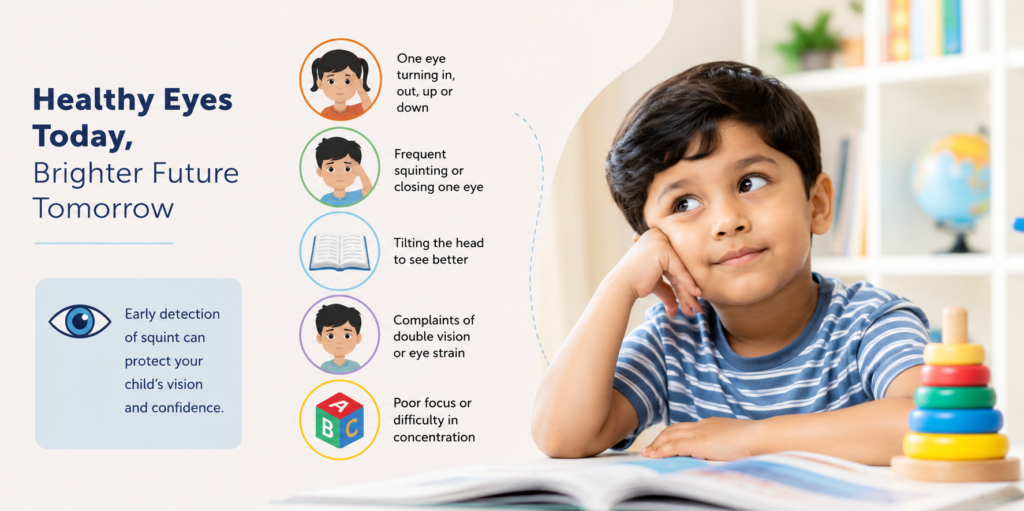
As a parent, you are often the first to notice something is not right with your child’s eyes. Signs that may indicate a squint include:
• One eye that turns in, out, up, or down — particularly noticeable in photographs (one eye may appear to look in a different direction)
• Eyes that do not appear to move together when following an object
• Closing or covering one eye in bright sunlight or when trying to focus
• Tilting or turning the head to one side to use the better eye
• Complaints of double vision in older children
• Squinting or frowning when looking at objects in the distance
• A white or unusual reflection in one eye in photographs (this can also indicate a more serious condition and must be checked immediately)
It is important to note that a squint should never be dismissed as something a child will ‘grow out of’. All suspected squints should be evaluated by an ophthalmologist as early as possible.
Is It a Squint or Just the Shape of the Face?
Infants often appear to have a squint because of the wide, flat bridge of the nose and the folds of skin at the inner corner of the eyes — a condition called pseudo-squint. As the child grows, the nose bridge develops and the apparent squint disappears. However, it can be very difficult for a parent to tell the difference between a real squint and a pseudo-squint — and this distinction must be made by a trained ophthalmologist. If you are in any doubt, have your child’s eyes examined.
How Is Squint Evaluated?
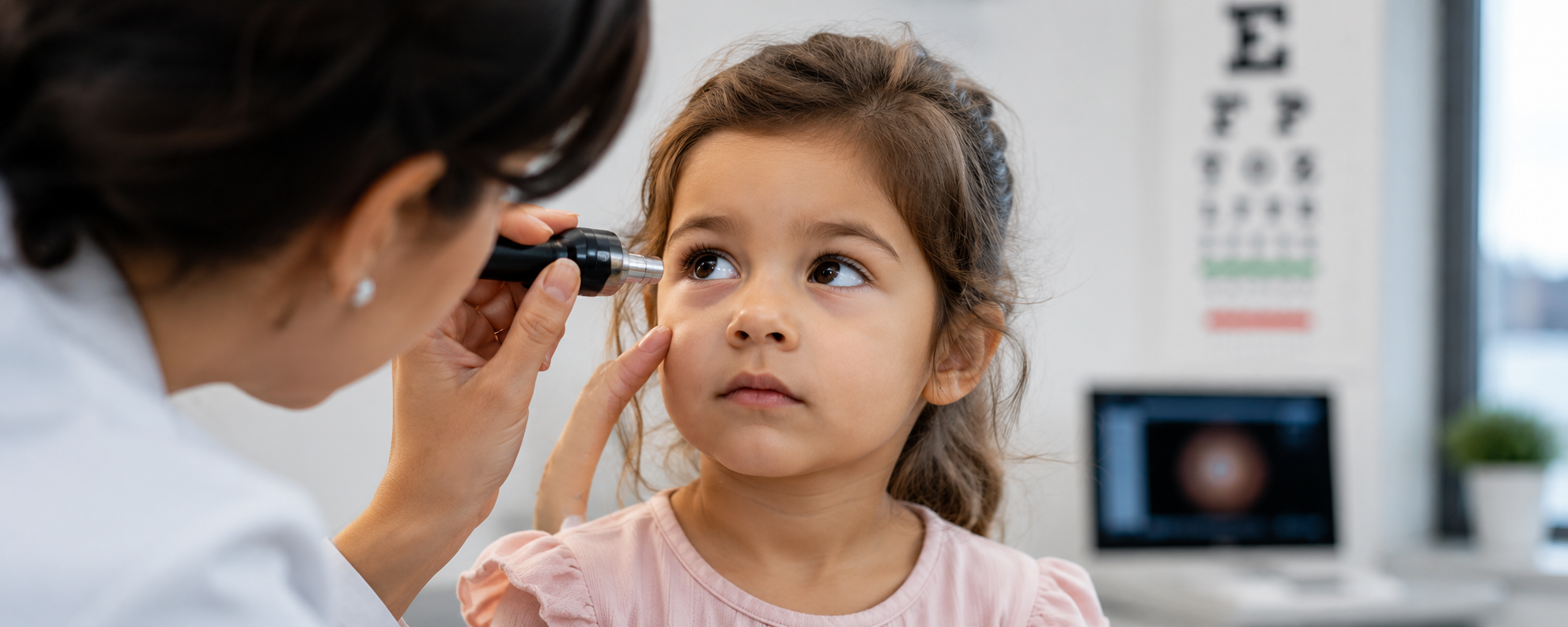
A squint evaluation at Dr. Ramesh Superspeciality Eye & Laser Centre with Dr. Amit Gupta includes:
• Vision testing: A full assessment of visual acuity in each eye — including tests suitable for pre-verbal children who cannot read an eye chart
• Refraction under drops: Cycloplegic refraction — special eye drops are used to temporarily relax the focusing muscles of the eye, allowing the accurate measurement of any glasses prescription. This is essential in young children.
• Squint measurement: Cover test and prism assessment — to measure the angle and type of squint
• Binocularity: Binocular vision assessment — to evaluate whether the two eyes are working together
• Ocular motility: Examination of the eye movements — to check for any associated weakness of the eye muscles
The assessment is adapted for the child’s age and is designed to be as comfortable and non-threatening as possible. Dr. Amit Gupta’s experience in paediatric ophthalmology ensures that even very young or anxious children can be examined thoroughly.
How Is Squint Treated?
Treatment of squint depends on its type, severity, and the age of the child. The goals of treatment are to restore good vision in both eyes, straighten the eyes, and develop the best possible binocular vision (the ability to use both eyes together as a team).
• Glasses: If a refractive error (glasses prescription) is the cause of or contributor to the squint, glasses must be worn full-time. In many children with accommodative esotropia (inward-turning squint caused by long-sightedness), glasses alone can straighten the eyes.
• Patching for amblyopia: Occlusion therapy involves patching the stronger eye to force the brain to use the weaker, amblyopic eye. This is a critical part of amblyopia treatment and must be done consistently during the period of visual development.
• Squint surgery: Squint surgery involves adjusting the tension of the muscles that control eye movement, to realign the eyes. It is performed under general anaesthesia in children and is a safe, well-established procedure. Dr. Amit Gupta performs all squint surgeries at Dr. Ramesh Eye Centre.
Surgery corrects the position of the eyes, but it does not restore vision lost to amblyopia — which is why treatment of amblyopia (patching) must begin before or alongside surgical planning. In many cases, a combination of glasses, patching, and surgery achieves the best outcome.
When Should My Child Have Their First Eye Check?
The Indian Academy of Ophthalmology recommends that all children have their first comprehensive eye examination by the age of 3 to 4 years — before they start school. Children with a family history of squint, amblyopia, or significant refractive error should be seen earlier.
Many children with squint, amblyopia, or significant refractive error have no obvious symptoms and appear to see perfectly well — because they adapt by using only their better eye. A formal examination is the only way to detect these conditions reliably.